
Do you own vintage University of Michigan pins (or buttons, as they were called)? Email me at mail[at]mvictors.com or find me at MVictors on Twitter or MVictors on Facebook with a photo. I’d love to see what you have, suggest a value, or answer any questions you may have. Here is the complete history of these antique pins:
I’ve always been interested in the evolving culture on campus at Michigan. Much has changed over our 200-year+ history, and many once-popular Ann Arbor traditions have faded away.
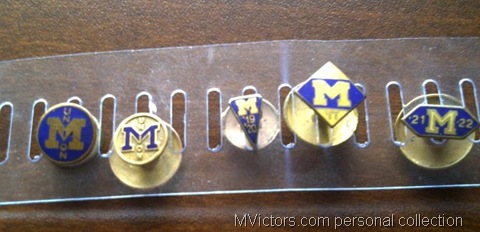
One lost tradition is the wearing of “Union buttons” around campus and at alumni events. For decades, these small lapel pins were distributed to students. They were typically made with glossy enamel, featured a block M, and displayed the school year. Early versions were 14k gold or sterling silver.
But the story of these vintage U-M lapel pins starts before the founding of the Michigan Union in 1904. Over time, this has confused people when they discovered similar-looking pins with earlier dates. This was discussed in this 1952 Michigan Daily article after a (nearly) complete collection of these pins was found at an Ann Arbor barbershop. The writer notes, “The origin of the pins and their relation to the Union is a mystery.”

It turns out the collection represented two different “pin” traditions at Michigan that eventually merged. The Union adopted a program that began with a group called The Athletic Association – the predecessor to today’s U-M athletic department and Michigan athletics booster clubs.
The Athletic Association
The roots of the Athletic Association date to November 1890, when the directors of the football, baseball, and tennis clubs on campus met to combine their groups to form a single entity. The purpose was simple: to use their common interest in sports to share fundraising, resources, and expenses for each of the major teams:

Starting in the early- to mid-1890s, the group used the sale of the association membership pins as a fundraising tool. Early versions of the buttons feature the azure/sky tone of blue, which was common around the turn of the century before the University colors were standardized to a darker blue in 1912. These “buttons” were sold to Association members, and eventually anyone on campus, to support various athletic endeavors. A portion of the proceeds went to the Association to cover administrative expenses like equipment, uniforms, fees for managers, etc.
This is a 1892 badge awarded to the winner in a mile run competition organized by the Athletic Association:

In the 1898-99 school year, membership to the Athletic Association cost $3. Beyond supporting the varsity teams, membership included a half-price discount to football, baseball and track events and access to the tennis courts on campus. And those students who didn’t join were subject to peer pressure:

In the early days, Association members were issued cards, and of course, enamel buttons. Here is the card from 1901:

We know that school administrators and even coaches supported the Athletic Association. He’s an early portrait of new football head coach Fielding H. Yost from 1901 wearing the button from that year (I believe the button colors are inverted/negative due to the photo processing of the day) :

Below is a catalog of the known Athletic Association pins. Note that these custom-designed pins took on a sporty look featuring items such as footballs, baseballs, gloves, and a track cleat. These pins were issued from the early 1890s until 1911.


The Michigan Union Takes Over
The origins of the Michigan Union date back to 1904 when a group of students and alumni gathered to discuss an important idea: they wanted a place on the growing Ann Arbor campus for students, groups, and alumni to meet, eat, share ideas, and socialize.
During this time, the athletic association pins were very popular if not cherished on campus – but of course, they had nothing to do with the Union. That all changed in April 1912 when the Athletic Association officially transferred the tradition of issuing the buttons each year to the Union.

The members of the Union knew the popular pins would be an incentive to attract members and collect dues. Keep in mind the Union, in its formative years, was more akin to a private club compared to the open campus gathering place that it is today. The pins came with a membership card–here is the first official “Union button” on its card for the 1912-1913 school year:

Starting with this transition, the designs moved away from the athletic themes and were replaced by varying geometric shapes to distinguish the pins from year to year. The new look still kept several basic features of the original athletic association concept: the block M logo, the digits of the school year, and a unique design each fall:


The final major change was standardization starting in 1933. The buttons moved away from the unique geometric-shape designs and adopted an established Union logo and included the school year until 1943-44:

The Undated Design
Starting in 1944 through the late 1950s or early 1960s, Union pins ceased issuing a unique pin for each school year. There are three known variations:

Life Membership Pins
Starting in 1913, a special gold button was given to those who paid to be a Union ‘Life Member’. Originally, this came with certain benefits, including access to the Union Hotel and priority for football tickets. From the Michigan Daily, November 1913:

There are two variations of the gold life membership buttons; the earliest were 10K gold produced by Whitehead & Hoag, later versions (likely starting in the 1930s) were manufactured by Burr, Patterson & Auld:

Commemoratives
The Union issued two different style commemorative pins in 2004 to celebrate the 100th anniversary of the founding of the Michigan Union. In addition, it is understood that Union board members have received a version of the pin below, this one issued in 2006:

Manufacturers
While these design standards were maintained, the manufacturer of the buttons evolved over the years. Here are the known companies that produced these pins:
- Wright Kay & Co – Detroit, MI
- Stauffer, Son & Co – (S.S. & CO.)
- William Arnold – Ann Arbor (WM ARNOLD)
- Burr & Patterson – Detroit, MI
- Whitehead & Hoag – Newark, NJ (WHITEHEAD & HOAG CO.)
- Bastian Bros – Rochester, NY (BASTIAN BROS.)
- Burr, Patterson & Auld – Detroit, MI
- HR Terryberry, Grand Rapids, MI
A 4,000-mile Journey
One final thought. It seems this tradition is lost in time. These pins and buttons were a tangible piece of a student’s experience on campus, and they were cherished. In an age where people didn’t keep artifacts and collectibles like we do today, we know that many Michigan alums held tightly onto and prized their Union pins.
Check out this great story from the May 18, 1947, Michigan Daily. A 1904 grad named Santiago Artiaga lost his home and all his possessions, including his Michigan Union pin, when the Japanese invaded the Philippines in WW2. After the war, he did something about it:

Artiaga contacted U-M and reportedly traveled 4,000 miles back to Ann Arbor to replace his beloved Union button! [Much more on Artiaga’s life and story here, in this Michigan Today piece.]
I hope you enjoyed this piece! If you found one of these pins let me know! Email me at mail[at]mvictors.com or find me at MVictors on Twitter or MVictors on Facebook with a photo.


2 Comments
Craig Cable
Thanks Greg. So comprehensive. You spent your summer vacation time appropriately LOL Can’t wait for next Pod.
Alan L Knaus
I graduated in December 1966 in Industrial Engineering. I have two M Union Pins, one of which you did not show. I also have an ID Tag for a life member. I think there was also a life member card but I can’t find it.
I can’t figure out how to send you the photos. If you could send me an email then I’ll share them.
BTW: We met last year at your Little Brown Jug lecture at the Observatory.